Cyber News
Cybersecurity Roadmap: How to Develop, Manage, and Make It Measurable
Developing a cybersecurity roadmap is one thing. Maintaining it over the long term, defending it before the Executive Committee, and proving that it actually reduces risk is another. This article provides a practical method for structuring your roadmap, managing it based on all its metrics, and presenting the right figures to the right audiences.
.png)

The accelerated digitization of financial services has transformed the risk landscape. Faced with increasingly sophisticated cyber threats, the European Union has responded with the Digital Operational Resilience Act (DORA).

A company's information system is a constantly evolving environment. Between diverse uses (teleworking, BYOD, OT, etc.) and multiple infrastructures (on-premise, hybrid, full cloud), companies must involve all their employees in order to strengthen their cybersecurity posture.

With the emergence of generative artificial intelligence and the dawn of Artificial General Intelligence (AGI), we wanted to imagine scenarios for using AI in cybersecurity solutions by 2050.
This fictional story aims to encourage you to reflect on your use of AI and offer you some food for thought.

Historically perceived as a technical expert, the CISO must now evolve into a communicator.
In a constantly changing work environment, the CISO—and more generally the IT security team—is responsible for guiding employees through a vision of what cybersecurity is and should be within the company. While this mechanism is based on sharing best practices and establishing common rules, it must be embodied by strong leadership on the part of the CISO.
But how can you communicate clearly within your organization? How can you share your challenges and priorities with your employees and get them on board? Our expert provides some answers and advice.

As risk and compliance management continues to grow in complexity, many organizations still rely on Excel spreadsheets and manual evidence collection, operating without real-time visibility. However, using a GRC (Governance, Risk & Compliance) tool is becoming essential...

New legislative requirements in the area of IT security are now an integral part of corporate governance. As a result, cybersecurity is no longer the sole preserve of the CISO, but is now a topic of interest and concern for executive committees and management teams, who need to have a clear understanding of the issues involved.
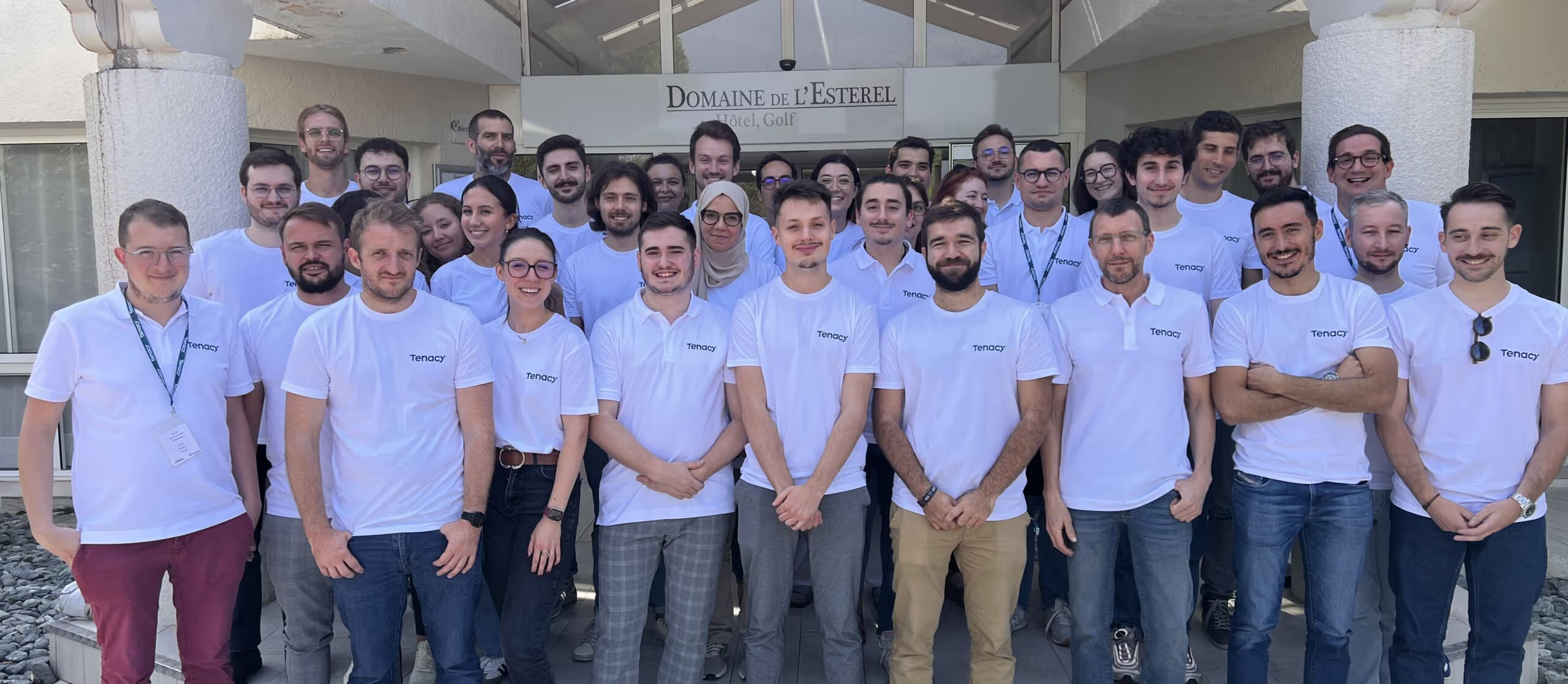
Tenacy, a SaaS platform for cybersecurity and compliance management, announces that it has raised €6 million in funding to accelerate its development in France and conquer the European market, starting with Benelux and Spain.
.webp)
What steps are involved in drafting a PSSI? What elements should it contain? And what pitfalls should be avoided? The answer in four steps...

As a CISO, your priority is to maintain the security of your company's information systems while constantly improving its cybersecurity performance.
But to improve performance, you need to monitor it: that's the purpose of key performance indicators (KPIs). Interpreting this data can be a daily challenge, especially for your senior management. So how can you tell if you have the right level of security, or if you are more vulnerable to attacks than other companies in your sector?

Mutuelle du Mans Assurance (MMA) in July 2020, Mutuelle Nationale des Hôpitaux in February 2021, Axa in May 2021, AssurOne in July 2021, April, Verlingue, Génération and Coverlife in November 2021, Caisse Centrale de Réassurance in July 2022, Emoa Mutuelle du Var in August 2022... The list of cyberattacks against insurers and mutual insurance companies continues to grow.
With the daily management of our personal and medical data, IT security is more than ever a major issue in the functioning of these industries. But what level of IT compliance must these sectors adhere to? And what are the challenges? Our IT compliance expert breaks it down.
The NIS Directive is the first European legislative act dedicated to cybersecurity. Faced with a series of upheavals in the economic and security context of European Union member countries, the current directive is evolving to respond to these new challenges. What does the reform of this new version consist of? How will this directive be transposed into French legislation? Are you affected by the requirements relating to the security of networks and information systems? We have deciphered the changes brought about by NIS 2!
To address current threats, you need to assess the security of your information system based on the challenges and risks facing your data. You must then define the security level of your IS and assess whether its assets are adequately secured. To help you with this process,the DICP risk analysis takes into account the various security requirements of your system and prioritizes them. You then analyze digital risks according to their availability, integrity, confidentiality, and evidence.