This new challenge requires C-level executives to get involved and understand issues for which they do not always have the necessary IT knowledge, in a field that is most often reserved for experts. At the same time, CISOs must adapt their communication to meet the needs of their management.
In this context, several questions arise.
- How can you, as a CISO, effectively communicate IT security issues to your management team?
- What are the expectations of C-level executives?
- How can technical issues be translated into tangible objectives for the company?
Explanations.
Management increasingly aware of cybersecurity issues
Corporate executives are becoming increasingly vigilant about the importance of cybersecurity, as indicated byESG's studyfor Trend Micro.
But while 82% of them acknowledge an increase in cyber threats, cybersecurity still seems too often confined to IT teams: according to 62% of respondents, it is primarily the responsibility of the IT department.
Good news: however, the study shows that decision-makers are becoming increasingly aware of the issue, with 85% of respondents observing growing interest in this topic among boards of directors.
Bad news: this emerging interest is very (too) often reactionary, arising after major incidents...
Cybersecurity remains a complex issue for executives
Despite this awareness of the risk, business leaders are struggling to grasp the challenges of cybersecurity. This trend is particularly noticeable in SMEs and mid-sized companies, where resources are often limited.
According to Bpifrance and Cybermalveillance.gouv.fr, this reluctance stems from several factors. First, understanding of cyber risks is often superficial, leading to an underestimation of the issues at stake and excessive delegation to the IT team.
To make matters worse,investing in cybersecurity products and solutions is often perceived as prohibitively expensive, even though the financial consequences of an attack can be catastrophic. According to a study by Orange Cyberdefense, 60% of companies that fall victim to a cyberattack file for bankruptcy within six months! It is therefore urgent to make cybersecurity understandable to everyone.
HOW TO TALK CYBER to your management?
The role of the CISO is no longer just to be a technical expert. They must evolve toward a more strategic and communicative role, which involves linking IT security issues to governance objectives and the company's business vision.
Talk about the business rather than the technical aspects with your contacts.
The primary goal of your discussion with management? To make them aware of the situation. To do this, you will need to highlight:
- cybersecurity issues;
- the consequences of risks (damage to reputation, unavailability of business processes, financial penalties, etc.);
- how these relate to the company's objectives.
As Baptiste David, Head of Market Strategy at Tenacy, explains, organizational management teams are interested in the commercial and budgetary repercussions of IT security risks, rather than the technical aspects and underlying organizational constraints: " The CISO must avoid technical jargon and speak the language of business to company executives. It's about explaining why certain situations are problematic and their potential impact on the organization. "
It is therefore important to simplify the terms you use in order to facilitate communication with management. On this point, you can refer to the white paper co-authored by OSSIR and CLUSIF: Cybersecurity for Executives, which provides a wealth of practical advice on how to make your message accessible, accompanied by a glossary offering simple definitions of terms such as DNS, BYOD, MFA, and phishing.
Base your speech on facts and figures.
To ensure effective communication, don't hesitate to project the consequences onto management. Highlight the consequences of a successful cyberattack on the company, such as the inability to use workstations throughout the company for 72 hours, or financial losses in terms of revenue.
Alongside this scenario, add a retrospective of significant cybersecurity events within the company. These events may include:
- internal security events;
- the results of a recent audit;
- the introduction of new regulations that have had an impact on corporate governance...
The idea here is to move from fiction to reality.
You can also monitor security incidents that have occurred in companies similar to yours (preferably French) to facilitate identification.
The goal is to keep management informed without overwhelming them with unnecessary details. The aim is to enable them to ask questions and understand cybersecurity trends that could affect their environment.
Do not multiply reports
Too much data kills data: to remain intelligible, don't produce too many reports!
Keep in mind that every report should add value for management—in other words, provide them with information that informs strategic decisions and highlights progress or identifies new challenges.
As Baptiste David points out: " An annual report is insufficient to keep up with the rapid evolution of cybersecurity issues, while a weekly frequency risks saturating management with redundant information."
For example, in the context of an ISO 27001 certification project that may take six months to complete, the most appropriate format would be a quarterly report to demonstrate progress and enable the right decisions to be made. And for more urgent issues or major incidents, ad hoc reports can be submitted without waiting for the next deadline.
Use Tenacy to support your analyses
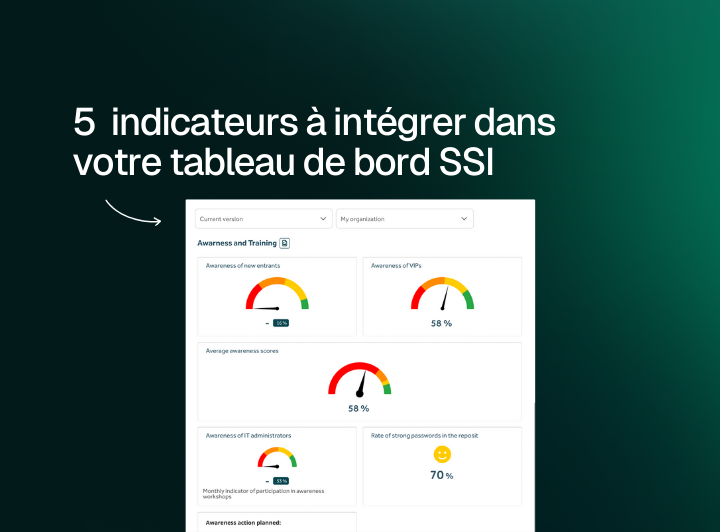
To facilitate the work of CISOs, the Tenacy platform provides detailed, contextualized analysis, enabling accurate, real-time assessment of the company's IT security posture. Advanced data visualization features transform technical information into clear graphs and tables, strengthening your communication with decision-makers.
This allows you to manage your company's cybersecurity, detect irregularities, and create reports that are understandable to everyone. A winning trifecta, in short!
Key points to remember
The role of the CISO is evolving beyond a purely technical function to become a strategic player within the company. It is now up to the CISO to translate cyber risks into commercial and budgetary implications and to present information that is both relevant and understandable to management in order to facilitate decision-making.
The use of platforms such as Tenacy facilitates this task by providing detailed, contextualized analyses that enable real-time monitoring of cybersecurity posture.
Contact our sales representatives now to request your Tenacy demo: https://www.tenacy.io/demo/