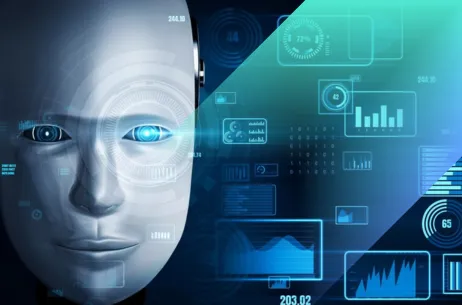
From machine learning to digital intuition
The year is 2049. Alexandre Renaud, Chief Information Security Officer (CISO), arrives as usual at the headquarters of UnityRisk, a leading insurance company in its market.
After turning on his workstation using his vital and biological parameter recognition, he checks his daily security diagnosis using ALFRED (Artificial Logic for Full-spectrum Response and Enterprise Defense). This artificial general intelligence (AGI) was designed to assist him in managing cybersecurity issues.
Since the late 2040s, the concept of identity has disappeared, with passwords being abandoned following the failure to develop post-quantum encryption.
To ensure user identification, AGI has evolved its concept of machine learning into digital intuition. This new capability allows artificial intelligence to make decisions in a context where some of the information needed for decision-making may be missing. It is a new paradigm that significantly increases detection thresholds, particularly through weak signals, and reduces false positives.
Digital intuition is everywhere and enables the implementation of adaptive, real-time policies to deal with cyber threats and extortion attempts. By 2050, "alert fatigue" will be a thing of the past, as SOC operators will have been replaced by software agents that develop judgment capabilities using digital intuition. This will be a response to the difficulties in recruiting cybersecurity professionals during the 2030s.
From the automatic configuration of network segmentation rules to monitoring standards and regulations, the entire corporate information system evolves in real time, much like an immune system that adapts its defense mechanisms in response to new pathogens.
Humans are no longer the driving force here: their role is to oversee the functioning of AGI.
In the context of the climate emergency, smart cities have become the norm.
In the context of the climate emergency, UnityRisk's premises are hyperconnected. Temperature, air quality, and water quality sensors, robots, drones: the company's environmental impact is continuously monitored by government agencies and must remain below a certain threshold, otherwise its activities will be immediately shut down.
For Alexandre Renaud, cybersecurity constraints have been joined by environmental constraints. For each cybersecurity requirement, an associated environmental cost that must not be exceeded must be taken into account.
That is why distributed edge computing infrastructures that host artificial intelligence models have replaced cloud-hosted instances, which consume too much water.
Controlled by AGI, in cold weather, these devices, which are installed in every room, heat the space using the heat they generate, thereby reducing energy consumption. In hot weather, these devices, which operate on a blockchain principle, distribute the load and switch off in turn so as not to exceed a predefined temperature indicator.
For the SSI team responsible for supervision, traceability is no longer limited to human employees within the company: it now includes the machine language of autonomous equipment such as robots, drones, and level 5 autonomous vehicles. Each company has developed its own standard, and the cybersecurity management platform instantly transcribes the data sources received by all connected equipment into a single format.
An enlarged attack surface
Technological innovations over the past 30 years have significantly expanded the attack surface. In 2050, the new Neuralink chips incorporate all the professional skills that a human operator needs to know to perform their job.
While a college degree is no longer a prerequisite for a position of responsibility, ensuring the accuracy of the information stored on the chip is a matter of safety and security for companies.
That is why quality control standards in the daily conduct of the company's employees and service providers are now incorporated into the new regulations.
Using surveillance cameras, AGI is able to detect suspicious behavior and notify the ISS team in order to record a compliance deviation and enable further investigation.
What if 2050 were actually tomorrow?
If our story seems fantastical to you, bear in mind that some of these concepts are already in use in 2024.
- Companies such as cybersecurity publisher Kaspersky are considering the creation of a concept of cyberimmunity that includes a pillar called "digital intuition."
- Cybersecurity publisher Juniper is currently developing features that enable computer networks to be self-configured using generative artificial intelligence (LLM).
- INRIA is currently working on two projects: AI@EDGE, a reusable, secure, and reliable artificial intelligence system hosted in an edge computing instance to replace cloud computing. And EDGE, an industrial project in partnership with Qarnot and ADEME, which aims to reuse waste heat from IT equipment to reduce the energy footprint of tomorrow's factories.
- In 2024, Elon Musk's company Neuralink has just implanted its first chip into a patient's brain with the aim of restoring mobility to people with disabilities. Several specialists are already wondering about the additional capabilities that Neuralink will be able to offer once its brain-machine interface is operational. One of these is adding skills to humans.
It is impossible to know what tomorrow will bring, especially in a field as fast-changing as cybersecurity. Nevertheless, it is always useful to look ahead and, in turn, question how we interact with AI today.
