Third-Party Risk Management: From Assessment to Long-Term Oversight
Third-Party Risk Management: From Assessment to Long-Term Oversight
Can your organization be compromised without being directly attacked? While your cybersecurity efforts have long focused on protecting your own environment, the cyber perimeter now extends far beyond what you directly control. Third-Party Risk Management (TPRM) involves identifying, assessing, and addressing the risks that your suppliers, service providers, and subcontractors pose to your organization. Far from ending with the assessment, this process continues for as long as the relationship lasts.
As part of a CESIN webinar, Thales and Tenacy developed a practical four-step method: identify your third-party vendors, assess them in sufficient depth, decide how to address each discrepancy, and then follow through on those decisions. In this article, you’ll find a supplier categorization matrix, a framework for determining the depth of assessment, and a decision-making matrix to help you transition from one-time assessments of your third-party vendors to ongoing management.
Why Third-Party Risk Management Has Become a Cybersecurity Governance Issue
Your attack area includes your flanks
Today, a growing portion of your business relies on organizations over which you have no direct control: cloud hosting providers, SaaS vendors, IT service providers, subcontractors, and others. Some of these organizations access your information system, while others process your data. Since a compromised service provider could spread the attack to its customers—through remote access, updates, or support processes— a vulnerability at one of your third-party providers can become a vulnerability for you.
Company leaders have clearly recognized this: according to the World Economic Forum’s Global Cybersecurity Outlook 2026, 65% of large companies cite vulnerabilities related to third parties and the supply chain as their main obstacle to cyber resilience, up from 54% a year earlier. The issue, therefore, is no longer just your own level of security, but also that of the organizations on which you depend. This is the crux of third-party cyber risk.
“Third-party risk cuts across procurement, legal, business units, and cybersecurity. It’s everyone’s responsibility—and therefore, in reality, no one’s.” Romuald Laisney, Product Marketing Manager, Tenacy
What NIS 2, DORA, ReCyF, and ISO 27001 Require
Managing third-party risks is no longer simply a best practice left to individual discretion: key regulations now include it among the obligations for cyber risk management.
NIS 2 : Article 21 lists supply chain security among the minimum risk management measures, including in relationships with direct suppliers and service providers. It requires taking into account each supplier’s specific vulnerabilities, the quality of its products, and its cybersecurity practices.
ReCyF : Published by ANSSI on March 17, 2026, the Cyber France Framework outlines the measures expected of future regulated entities, including an action plan with a designated person in charge and a deadline, as well as formal acceptance of residual risks.
DORA: Effective for the financial sector as of January 17, 2025, Article 28 makes risk related to ICT service providers a component of the ICT risk management framework. It requires a registry of information on contractual agreements and exit strategies for critical or important functions, and reiterates that the financial entity remains fully responsible for complying with its obligations.
ISO 27001 : Clauses 5.19 through 5.23 of Annex A provide a framework for relationships with suppliers (contractual requirements, ICT supply chain, service monitoring, cloud services). Clause 6.1.3 requires that risk owners approve the treatment plan and accept the residual risks.
While these texts do not apply to the same entities, they agree on the essential point: an evaluation is only valuable insofar as it leads to decisions and their follow-through. Responsibility, however, cannot be outsourced through a contract.
“The ReCyF requires, in three separate provisions, that a responsible party and a deadline be specified for each action. When a regulator makes the same request three times, it means it intends to follow up on it.” Romuald Laisney, Product Marketing Manager, Tenacy
The establishment of the relationship is formalized, but its long-term management is much less so
In April 2025, Marks & Spencer experienced this scenario. According to its chairman, Archie Norman, the initial breach occurred on April 17: the attackers impersonated an employee to trick a third-party vendor into resetting a password. The attackers then moved laterally within the environment and deployed ransomware. Online orders were suspended on April 25 and did not resume until June 10, and click-and-collect service did not return until August. In its annual results published in May 2026, the retailer estimated the direct costs related to the incident at £131.3 million, partially offset by £100 million in insurance payouts. The point of entry was not a technical vulnerability in M&S’s systems, but rather a support process outsourced to a third party.
This is not an isolated case. In the World Economic Forum’s Global Cybersecurity Outlook 2026, 65% of large companies cite vulnerabilities related to third parties and the supply chain as their main obstacle to cyber resilience, up from 54% in 2025.
In France, the CESIN 2026 Barometer confirms this vulnerability: 43% of large companies cite indirect attacks via a third party.In response to this risk, most organizations have established a structured approach to third-party management from the outset of the relationship: security clauses in contracts, pre-signing questionnaires, and sometimes a security assurance plan. Such a framework is useful, but it remains contractual and declarative—and therefore static. It describes a supplier at the time of signing, but what happens to that supplier afterward? And how does the organization address any identified discrepancies?
“A contractual clause is a written promise: it’s essential, but it doesn’t say whether it will be fulfilled. Six months after signing, the supplier may have switched hosting providers, brought in a new subcontractor, or experienced an incident—the initial assessment no longer reflects reality.” Romuald Laisney, Product Marketing Manager, Tenacy
A score is not a decision, and an assessment that does not result in any action, written acceptance, or a date for reconsideration remains merely a record on file. This is precisely what the regulations seek to avoid, and what an auditor will examine: not the number of questionnaires sent out, but what was done with the responses.
Step 1: Identify and map out your third parties before evaluating them
What Makes a Third Party Critical: Services Provided, Access, Data, Dependency
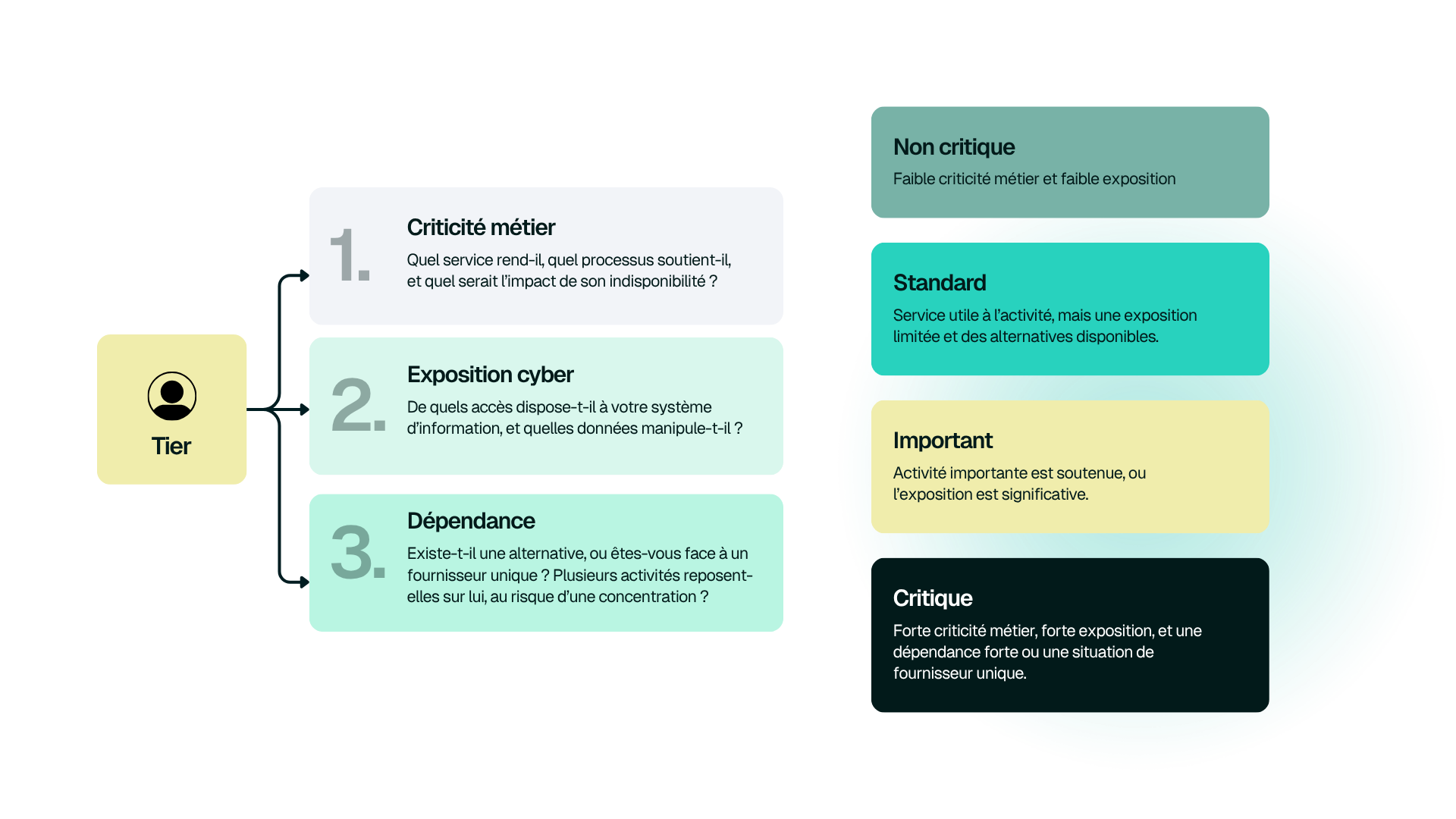
Before determining whether a supplier is secure enough, you need to establish why it matters to you. There are three factors to consider whenassessing the criticality of your suppliers:
Business criticality: What service does it provide, what process does it support, and what would be the impact if it were unavailable?
Cyber exposure: What access does it have to your information system, and what data does it process?
Dependency: Is there an alternative, or are you dealing with a single supplier? Do multiple business activities rely on this supplier, creating a risk of market concentration? The ANSSI’s EBIOS Risk Manager method combines dependency and penetration to measure exposure to a stakeholder.
The total value of purchases remains a useful indicator, but it is not sufficient on its own: a supplier with a contract worth a few hundred thousand euros may be far more critical than one with a contract worth several million, simply because its service is difficult to replace.
The Four Levels of Criticality
Criticality analysis is only valuable if it is translated into operational categories. A four-level scale makes it possible to cover an entire portfolio without creating an excessive number of special cases.
Non-critical: low business criticality and low exposure.
Standard: A service that is useful for business, but with limited exposure and available alternatives.
Important: A major activity is supported, or exposure is significant.
Risk Assessment: High business criticality, high exposure, and a high degree of dependency or a single-vendor situation.
To be truly useful, a criticality must trigger predefined rules —such as the depth of evaluation, the frequency of reassessment, or the level of decision validation.
“ The more critical a supplier is to our business, the more exposed it is to our environment, and the harder it is to replace, the higher the expected level of control must be. This classification allows us to tailor requirements to each category, rather than applying a one-size-fits-all approach.” Chloé Paineau, Cybersecurity Governance Consultant Manager, Thales
Steps for Assessing the Criticality of Third Parties
An operational map, developed in collaboration with Purchasing
Reliable categorization requires reliable information: if you only have a supplier name, a purchase amount, and a generic email address, you will not be able to classify the relationship or conduct a meaningful evaluation later on.
Third-party mapping is therefore not simply an inventory or a supplier directory: it is an operational database. For each relationship, it must document the service provided, the user entity or business unit, the applications involved, the access rights granted, the data processed, and the appropriate contacts on the supplier side. Its quality determines the success of the entire process. This is also the rationale behind the information registry required by DORA, which is maintained on a per-agreement basis.
This work cannot be done alone. The Procurement team knows the suppliers, contracts, committed amounts, deadlines, and key contacts—they provide the business perspective. The cybersecurity teams provide insight into exposure and risks. By combining these two perspectives, you obtain a map that reflects both the reality of the business and the security challenges. Contract deadlines, in particular, will serve as key reference points for evaluating your suppliers over the long term.
Mapping and Classifying Third Parties in Tenacy: Supplier Profile and Criticality
In Tenacy, each supplier has a profile that includes their contact information, criticality, and other information relevant to their qualification. Your supplier database is no longer a collection of scattered files between Procurement and IT—it becomes a shared, up-to-date database. By classifying your suppliers according to your own criteria, you assign each one a category that guides subsequent actions: the depth of evaluation, follow-up priorities, and reporting.
Step 2: Assess at the appropriate level: state, demonstrate, test
Balance the effort with the risk
Once your third parties have been qualified, it might be tempting to send them all the same questionnaire. However, sending 300 questions to 2,000 suppliers doesn’t help anyone. To assess a supplier’s cyber risk, the effort must be tailored to its category. Distinguish between two things: the set of requirements (what you expect from the supplier) and the method for verifying compliance. The former can be standardized, while the latter varies depending on the supplier’s criticality.
Develop your requirements matrix by cross-referencing the standards relevant to your context: ISO 27001, NIS 2, NIST, ISO 42001 for AI, or industry-specific standards such as DORA, Part-IS, or IEC 62443. This will spare the vendor from having to undergo multiple redundant assessments. Moreover, complying with DORA does not mean evaluating your service providers using a checklist modeled after the regulation—it is sufficient for your checklist to cover the topics it mandates.
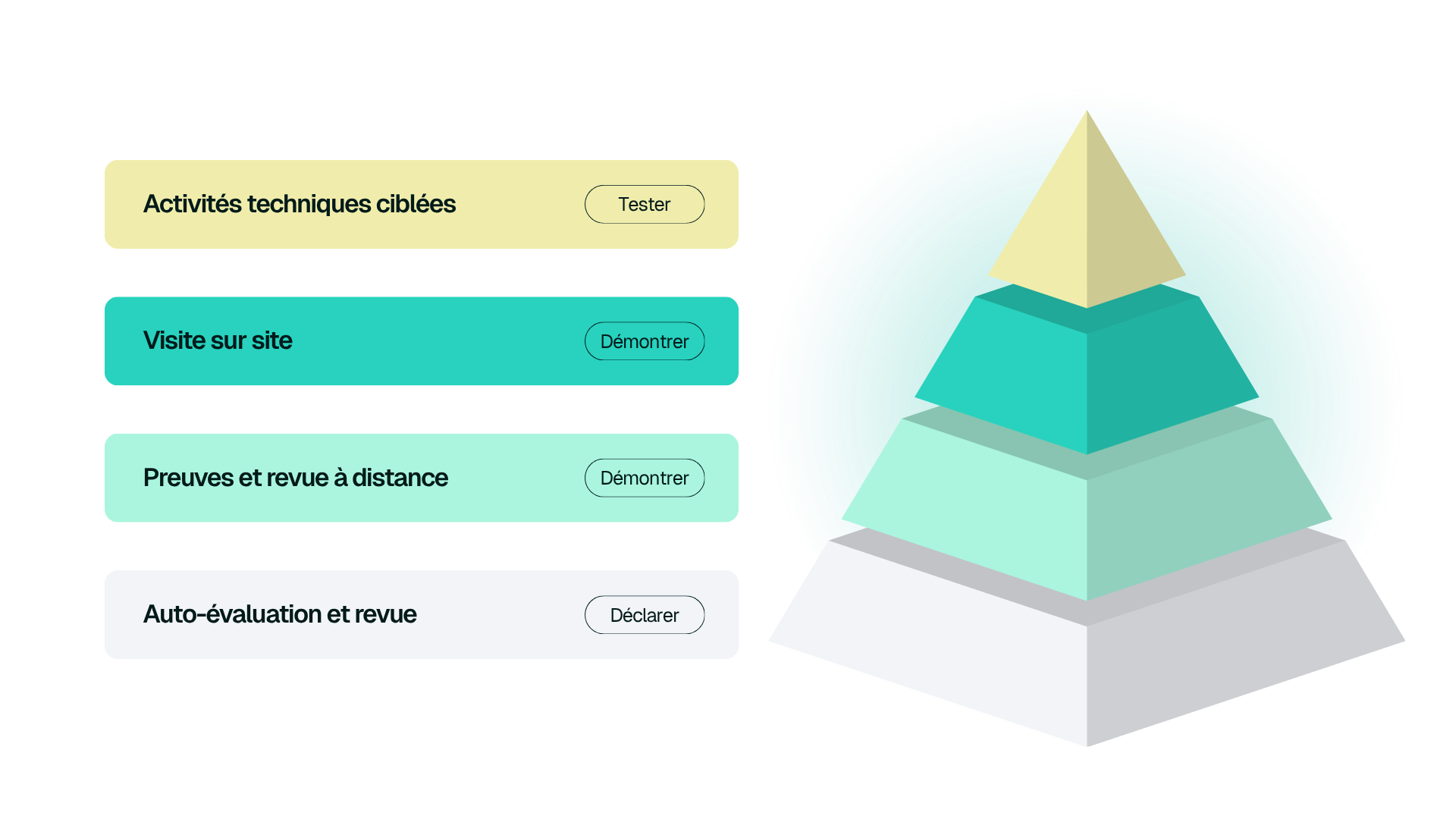
The Depth Pyramid: From Self-Assessment to Technical Testing
The Depth Pyramid: From Self-Assessment to Third-Party Technical Testing
The audit proceeds in four stages, from self-reported to verified.
Self-assessment: The supplier completes your evaluation form, and you analyze their responses. This approach remains self-reported, and its value depends on your ability to question the consistency of the responses. It may be sufficient for non-critical or standard suppliers.
Remote evidence and reviews: policies, procedures, audit reports, test results, certifications, configuration details… you’re moving from declarations to facts. This is the standard expected of major suppliers.
On-site visit: This process verifies that statements align with operational reality—such as physical access points, sensitive areas, and employee arrivals and departures.
Targeted technical activities, reserved for critical suppliers: architecture review, Active Directory configuration, penetration testing, incident response drills, and business continuity testing.
The goal is not to carry out every activity systematically: each activity must address an identified risk. This takes you from simply reporting to demonstrating, and then from demonstrating to testing. The expected outcome is not just another report, but a list of prioritized nonconformities and a corrective action plan developed in collaboration with the supplier.
Certifications and Audit Reports: Verify the Scope Before Relying on Them
An ISO 27001 certification, a SecNumCloud qualification, or a SOC 2 report saves you from having to ask again for what the provider has already demonstrated—provided you read what it actually covers. Check its scope (sites, services, and entities covered), its validity date, and—for ISO 27001— the statement of applicability, which specifies which measures are included or excluded. A certificate that does not cover the service you are purchasing proves nothing to you.
The same rigor is required for responses: demand proof when the stakes warrant it, especially when a key supplier claims to be compliant. A business continuity plan (BCP) attached to the response—dated 2019 and never tested—does not demonstrate any capacity for business continuity. In that case, reject that specific response with a comment, rather than the entire questionnaire: the dialogue continues, and the discrepancy is documented.
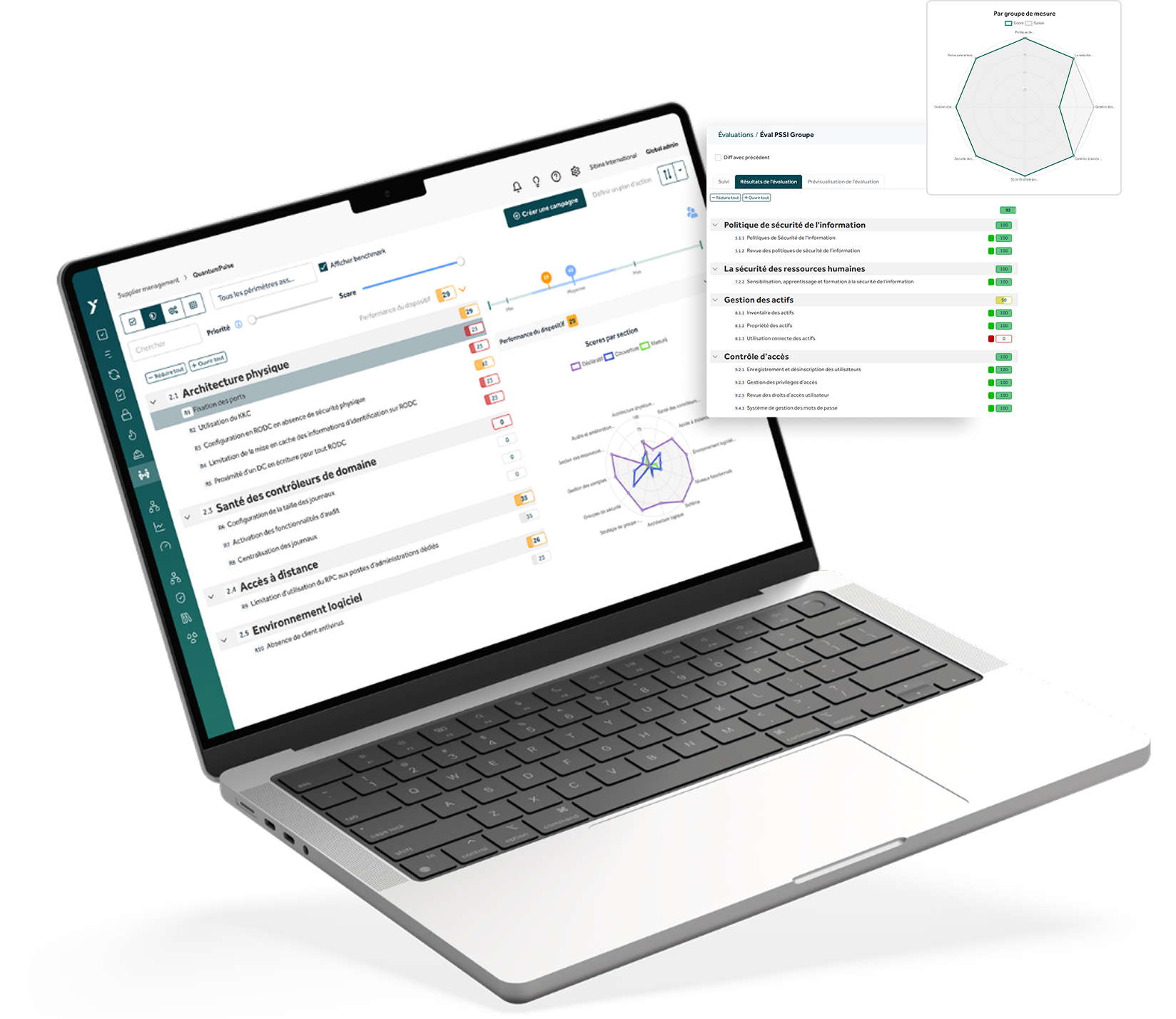
Evaluating and Following Up with Third Parties in Tenacy
Assess using a questionnaire and follow up in Tenacy
With Tenacy’s evaluation campaigns, each supplier receives requirements tailored to its profile: you can scale your efforts without having to create multiple questionnaires. Suppliers respond directly on the platform, providing supporting documentation, which eliminates the need to exchange spreadsheets via email. Since you can track the progress of each third party and send a single follow-up to those who haven’t responded, your campaigns move forward without the need for manual follow-up.
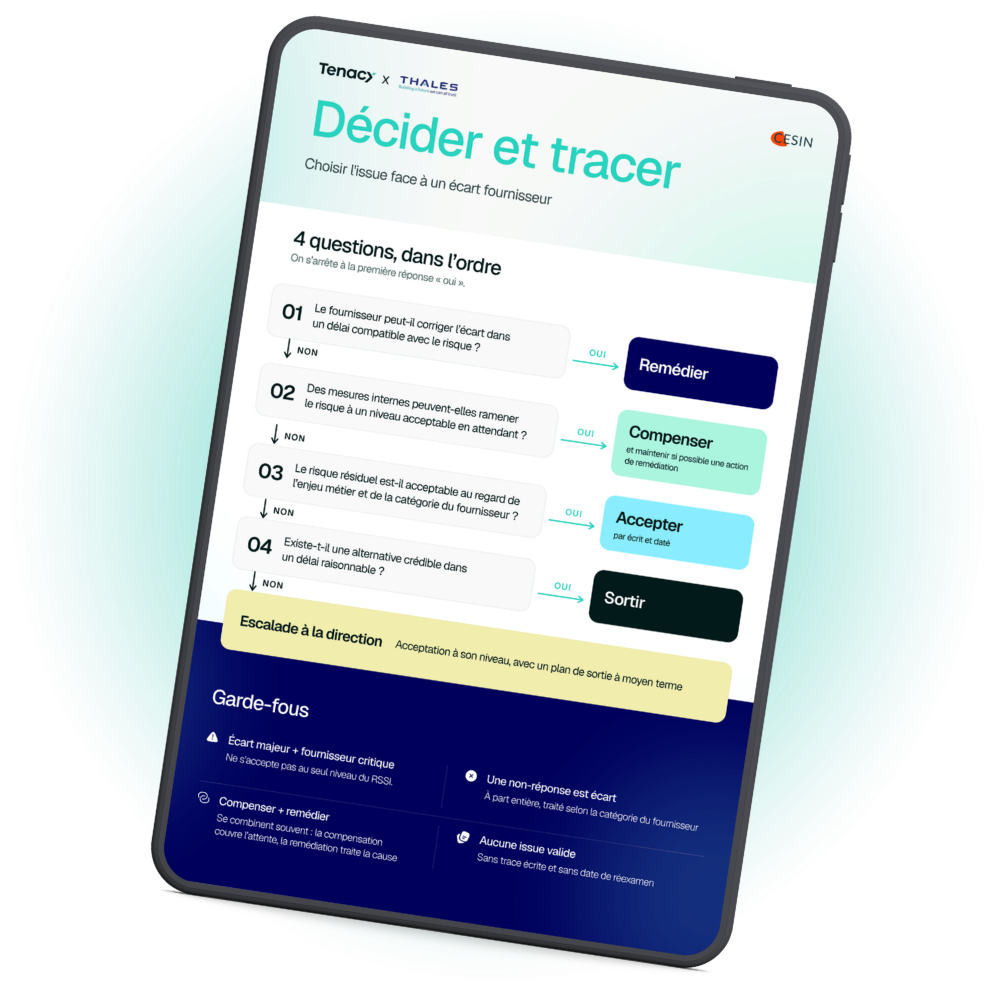
Step 3: Process and Decide: Address, Compensate, Accept, or Walk Away
A discrepancy becomes a task with an assigned person and a deadline
Once the assessment is complete, every significant discrepancy must lead to a decision. As stipulated by ReCyF, each action in the treatment plan must have a designated person in charge and a deadline.
“An assessment reveals a gap, and everyone agrees that action is needed. Procurement believes that follow-up is the responsibility of cybersecurity, cybersecurity believes it’s the responsibility of the business units, and the business units consider the matter closed since the contract has been signed. Three months later, no one knows anymore who was supposed to do what. Without a person in charge, no one takes ownership of the task; without a deadline, it has no end.” Romuald Laisney, Product Marketing Manager, Tenacy
As soon asa deviation is identified, it is converted into an action item, with a designated person in charge and a deadline set at the time it is created. The action item is closed only upon verification, and this verification is retained for potential audits. For a critical supplier, verification of closure may involve a new test or a follow-up visit: the pyramid in Step 2 is also used to verify that the issue has been resolved.
The Four Possible Outcomes When Facing a Deficit
When faced with a discrepancy, there are four possible outcomes.
Correct: The supplier corrects the nonconformity within a timeframe appropriate to the risk. The action is tracked until closure is confirmed.
Mitigation: Correction is not possible in the short term; internal measures are being taken to reduce the risk in the meantime. These measures are described, have a time limit, and are reviewed on a set date. The gap remains open.
Accept: Neither correction nor compensation is sufficient, but the business implications justify proceeding. Acceptance is justified, time-limited, validated by an authorized approver, and accompanied by a date for review.
Exit: The discrepancies are serious or recurring despite remediation plans, and a credible alternative exists. The decision is formalized, along with a migration plan and data handover.
To make your choice, ask yourself the following four questions in order.
Can the supplier correct the discrepancy within a timeframe that is consistent with the risk? If so, take corrective action.
Otherwise, can internal measures reduce the risk to an acceptable level in the meantime? If so, compensate.
Otherwise, is the residual risk acceptable given the business implications and the supplier’s category? If so, accept it in writing.
Otherwise, is there a credible alternative within a reasonable timeframe? If so, leave.
If the answer to each question is “no,” escalate the issue to management: seek approval at that level, along with a medium-term exit plan. Keep in mind that the greater the dependency, the more difficult the exit will be: this is where the analysis from Step 1 shapes the decisions.
“All four approaches are legitimate, provided they are well-documented, but each has its pitfalls. Remedying the issue risks setting an unrealistic deadline that is accepted out of complacency. Compensating for the issue makes people forget that the gap remains: compensation addresses the symptom, not the cause. A verbal agreement reached in a meeting quietly becomes permanent. And withdrawing from the contract sometimes reveals that the contract does not provide for any reversibility.” Romuald Laisney, Product Marketing Manager, Tenacy
The four possible outcomes when faced with a gap, illustrated by three typical suppliers:
Issue
Example
Conditions of Validity
Remedy
SaaS HR provider handling payroll data (Important), without MFA on administrator accounts: deployment within 3 months, proof provided.
Action monitored until final settlement.
Compensate
Cloud hosting provider (Review), disaster recovery plan (DRP) not tested in two years, cannot be replaced in the short term: internal resilience and monitoring measures are in place pending the test, which is scheduled as a separate action.
Measures that are described, time-limited, and reviewed on a fixed date. The gap remains open.
Accept
Marketing application with no sensitive data (non-critical), does not comply with the password policy.
Justification, time limit, authorized approver, review date.
Go out
An HR SaaS provider with recurring major discrepancies despite several remediation plans, with a credible alternative: planned migration.
Formal decision, migration plan, data restoration, project-based monitoring.
{{cta-lead-magnet}}
What should you do if a supplier doesn't respond?
A “no response” is a response in itself: a supplier who does not complete the questionnaire or provide the requested evidence is signaling a risk, which should be treated as a nonconformity in its own right. Establish a written rule in advance that is proportionate to the category.
For a non-critical supplier, the signing can wait until the questionnaire is completed. For a critical supplier, the policy calls for escalation, the suspension of new projects, and a documented decision: compensate, accept, or terminate.
“When dealing with a critical supplier who doesn’t respond after three follow-ups, the lack of guidelines leads to improvisation, and in practice, project pressure takes precedence: the business needs the supplier, the project starts on Monday, so we sign the contract without an evaluation, telling ourselves we’ll figure it out later. And ‘later’ never comes.” Romuald Laisney, Product Marketing Manager, Tenacy
Draft a risk acceptance statement that will hold up under scrutiny
Accepting a risk is legitimate, provided it is in writing, signed, and dated. This is the meaning of clause 6.1.3 of ISO/IEC 27001: risk owners formally accept residual risks. To stand up to an audit, a supplier risk acceptance must, at a minimum, specify:
the supplier, its category, and the service in question;
the discrepancy identified and the relevant requirement;
the level of residual risk;
Justification: business imperative, lack of alternatives, disproportionate cost of correction;
any compensatory measures;
the expiration date and the events that would cause the decision to be reopened;
the approver, their position, and the date.
The level of approval depends on the category: a major deviation involving a critical supplier cannot be approved solely at the CISO level, but must be addressed by senior management or the risk committee.
Turn gaps into actions and track risk acceptances in Tenacy
A supplier assessment that ends up in a shared folder is useless on the day of the audit. In Tenacy, the issues identified during the assessment become an action plan in just a few clicks, with an assigned person and a deadline for each action. The issues you choose to accept become formal exemptions: justified, approved, and dated. And since Tenacy flags exemptions that are nearing their deadlines, a temporary exception doesn’t become permanent without anyone noticing. On audit day, everything is in one place: the responses, the evidence, the actions taken, and the accepted risks.
Step 4: Ensure Long-Term Management
Reevaluate based on category and triggers
An evaluation provides a snapshot of a supplier at a given point in time. To ensure its reliability, establish a reevaluation frequency for each category. For example: annually for critical suppliers, and upon contract renewal for non-critical suppliers. Certain events may also warrant a reevaluation before the scheduled date:
an incident at the supplier's facility;
a change in scope or subcontractor;
contract renewal;
changes to your requirements matrix—for example, to incorporate risks related to AI or post-quantum cryptography, or a new regulatory requirement.
“An annual reassessment that ignores an incident that occurred in March is of limited value.” Romuald Laisney, Product Marketing Manager, Tenacy
Review risk acceptances upon their expiration
An acceptance without a review date becomes permanent without anyone having made that decision. Each acceptance must therefore be reviewed when it expires—for example, every six months for a critical supplier, and every twelve months for others. At that time, there are three options: renew it in writing, convert it into a corrective action, or begin the termination process.
Three metrics to report to management
Third-party risk must be brought up to the same level as internal risk. Three indicators are sufficient to report on this to management:
the percentage of critical suppliers evaluated over the past 12 months;
the number of open discrepancies that have been open for more than six months;
the number of risk acceptances or waivers that have expired without being reviewed.
“The percentage of critical suppliers assessed over a 12-month period indicates whether we’re actually covering the ones that matter. Open issues that have been pending for more than six months show whether we’re truly addressing them. Exemptions that have expired without review reveal whether we’re following through on our own decisions. With these three metrics, third-party risk becomes measurable—and thus can be discussed at the appropriate level.” Romuald Laisney, Product Marketing Manager, Tenacy
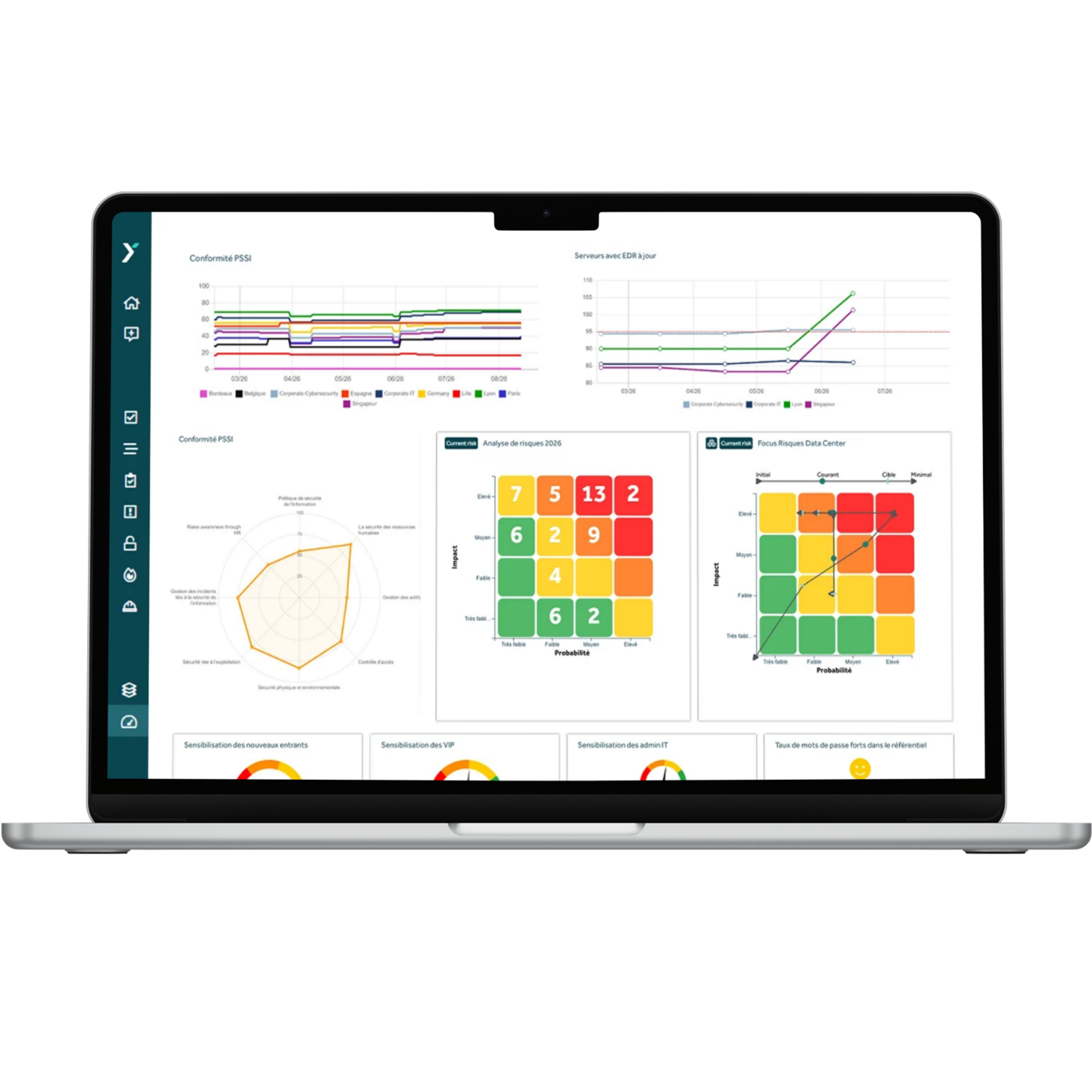
Track Your Key Performance Indicators in Tenacy
Tenacy's dashboards consolidate assessment progress, ongoing actions, and acceptances requiring review. By filtering these dashboards to focus on your critical suppliers, you can report to management without having to reprocess data, and you can concentrate your efforts where the risk is highest.
Manage Third-Party Risks with Tenacy
Managing Third Parties in Tenacy
By managing your third parties in Tenacy—the same GRC (governance, risk, and compliance) platform you use for compliance—you streamline the end-to-end process: qualifying, evaluating, deciding, and managing —all within a single environment. Decisions made regarding a supplier follow the same workflow of approvers, deadlines, and evidence as your ISO 27001, NIS 2, or DORA requirements. You report on supplier risk using the same dashboards as the rest of your cybersecurity governance. To see how Tenacy supports each of these steps, request your personalized demo on the TPRM use case.
Five Key Habits to Remember
Qualify before evaluating: Understand why a supplier matters before assessing its security.
Adjust the depth: state, demonstrate, test, depending on the category.
Turn every discrepancy into a written decision, assigning a person in charge and a deadline.
Agree, but date, sign, and review it.
Long-term management: Reassess based on category and triggers.
Would you like to learn more about Tenacy's features?
Tenacy is the GRC platform for cybersecurity teams that manage multiple repositories across various entities. A single, one-time process covers all your obligations, and your security posture remains up to date and transparent—both at the subsidiary level and across the entire group. You no longer have to argue your cybersecurity strategy—you demonstrate it.
Third-Party Risk Management: From Assessment to Long-Term Oversight
Can your organization be compromised without being directly attacked? While your cybersecurity efforts have long focused on protecting your own environment, the cyber perimeter now extends far beyond what you directly control. Third-Party Risk Management (TPRM) involves identifying, assessing, and addressing the risks that your suppliers, service providers, and subcontractors pose to your organization. Far from ending with the assessment, this process continues for as long as the relationship lasts.